
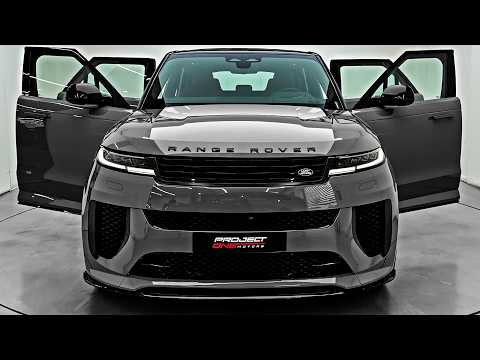
Range Rover Sport SV review – A Defender OCTA in a suit
Range Rover’s Sport SV blends ultimate SUV performance with a sense of luxury previously reserved for Range Rovers and it’s all the better for it.
Remember the old Range Rover Sport SVR? Painted bright blue, with a pair of Recaro seats that wouldn’t look out of place in a Jaguar Project 8 and an exhaust system that came out of the factory set to obnoxious mode? Its replacement is nothing like that, and that’s a very good thing. What you’re looking at is one of the most accomplished fast SUVs of them all – which it needs to be, because despite what you thought of the old SVR, in terms of financial performance, no model in the Land Rover line up got close to it.
The latest Range Rover Sport feels more like a smaller Range Rover rather than an SUV with genuine sporting pretensions, even in P530 V8 guise. Its refinement, comfort and material quality are far closer to luxury than anything sporting. The SV, meanwhile, aims to address that with chassis tech you’d normally expect to find under a cutting-edge sports car. We’ve driven the SV on the road and on track, to put it through its paces. With a lower entry price of £146,195, it really gives the £210,000 Aston Martin DBX S something to think about.
Supercharged V8 replaced by twin-turbo BMW unit
Interconnected 6D hydraulic suspension handles platform control
First time Land Rover has offered carbon ceramic brakes
Land Rover has thrown everything at the SV to create a credible competitor to the likes of the Porsche Cayenne Turbo E-Hybrid and Aston Martin DBX S – SUVs that are enjoyable and dynamic to drive despite every element of physics working against them.
It’s essentially a front-engined, rear-drive car, with an e-diff at the rear and a centre diff that JLR also describes as an e-diff (it’s a multi-plate clutch) sending drive to the (open) front diff via a shorter propshaft. Up to 50 per cent of drive can go to the front axle and the mode selected sets the level of rear-drive bias, from around 70 per cent in Comfort, up to 80 per cent in SV mode, though with no drive to the front when cruising.
The clever stuff on the Sport SV – and the Land Rover Defender Octa – to take the dynamics to another level is JLR’s bespoke ‘6D’ system. Indeed, 6D seems to be the current buzzword in the motor industry and it describes a vehicle’s movements – lateral, longitudinal and vertical, plus pitch, roll and yaw.
A 6D controller monitors and, if you have enough ‘levers’ to pull, helps manage the vehicle’s behaviour. The Sport SV has plenty of levers, notably hydraulically interlinked dampers and height adjustable air springs, which are very useful both off-road and on.
In terms of fast driving, the key things that JLR has been able to manage are pitch and roll, helping contain and control the substantial weight of the SV so it doesn’t dictate its dynamic behaviour. Agility meanwhile is aided by the quicker steering ratio and bespoke rear-steering.
The Carbon ceramic brake discs – the first fitted to a Range Rover and developed by Brembo – are an option and measure 440mm at the front, 390mm at the rear and their eight-piston calipers feature an X-pattern design to maximise braking performance. Fitting 23-inch carbon wheels and the carbon ceramics saves over 70kg in unsprung mass.
Read More https://www.evo.co.uk/land-rover/range-rover-sport/sv
Instagram ▶ https://www.instagram.com/cartvpress
TikTok ▶ https://www.tiktok.com/@cartvpress
Facebook ▶ https://www.facebook.com/CARTVPress